
Firs Primary School
Maths
Last Updated: September 2026
White Rose Maths
As a school we have decided to follow White Rose Maths. The White Rose schemes of learning are designed to support a mastery approach to teaching and learning, as well as to support the aims and objectives of the National Curriculum.
The White Rose schemes have number at the heart and a lot of time is spent reinforcing number to build competency. It also provides opportunities to build reasoning and problem-solving into each lesson.
White Rose believes that all children, who are introduced to a concept, should have the opportunity to build on their abilities by following a concrete-pictorial-abstract approach.
Concrete – children should have the opportunity to use concrete objects to help them understand what they are doing.
Pictorial – alongside concrete objects, children should use pictorial representations. These representations can then be used to help reason and solve problems.
Abstract – both concrete and pictorial representations should support children’s understanding of abstract methods.
Tackling Tables & Tackling Add and Subtract
At Firs, we understand the fluency and quick mental recall of mathematical facts is the basis of children being able to succeed in their maths lessons. We prioritise the practising of these skills using “Tackling Tables” and “Tackling Add and Subtract.”
Tackling Tables and Tackling Add and Subtract is used throughout the school to help children develop key number skills. It is an interactive, team game where children work in groups of 2 or three to test each other on multiplication and division or addition and subtraction facts. For both sets there are three different levels and children are baselined and tested to progress through the levels.
Tackling Timestables: Blue (1, 2, 5, 10), Green (3, 4, 8) and Red (all others).
Tackling Add & Subtract: Purple (number bonds, doubles and near doubles), Yellow (number bonds, multiples of 10 and addition of double and single digit), Orange (addition of two double-digit numbers and double-digit number bonds).
Tackling Timestables is used in year 2 and throughout KS2. Tackling Add and Subtract is used throughout KS1. It is also used as an intervention by adults to help fill the gaps in learning for pupils.
My Maths
All children have a login for “My Maths.” This is used in a variety of ways across the school: to give the children an opportunity to practise their fluency and mental recall skills through the games; completing tasks in school that follow up what they have been learning; and set activities for home learning.
Children have the opportunity to go on “My Maths” both at home and at school.
Dreambox Maths
All children have access to “DreamBox Maths”, an engaging online maths programme that adapts to each child’s individual learning needs. It gives children the opportunity to practise key maths skills, build their confidence and develop their understanding through fun, interactive activities. DreamBox Maths works as an addition to our classroom teaching, helping children to practise what they have learned, strengthen areas they find more challenging and develop their fluency, reasoning and problem-solving skills.
Children have the opportunity to go on “My Maths” both at home and at school.
Maths at Firs
At Firs, we follow the order White Rose Maths and use the small steps to help us build up to age-related objectives. Maths classes are taught in ability groups. In some KS2 classes, maths is taught in mixed age group classes. During these maths lessons, the class teacher is aware of the different expectations of the different year groups (such as in Number and Place Value, Year 3: compare and order numbers up to 1,000 and Year 4: order and compare numbers beyond 1,000). The guidance for these mixed aged classes can be found at the bottom of the page.
At Firs, we are passionate about ensuring that the learning is at the correct level for the child and allows the child to move at their own pace but always be challenged. This allows for all children to ensure they are secure in a method/concept before moving on. We ensure that all children have the opportunity to apply new methods/concepts learnt through problem-solving and reasoning. Our maths lesson structure can be seen below.
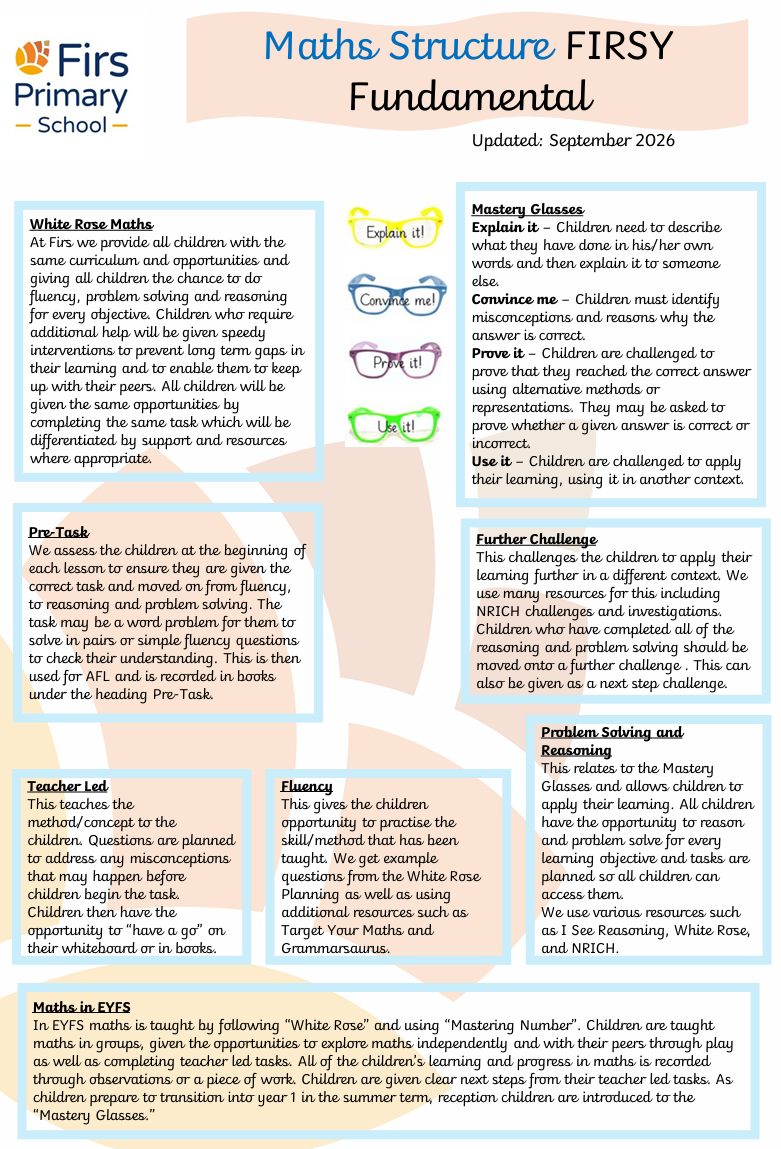
Firs Progression Statement
Although we follow the White Rose Maths progressive curriculum and use the ‘Small Steps’ to plan and support the sequencing of our own lessons, we recognise that due to the diverse needs of our pupils, including SEND, disadvantaged, EAL, New to English or gaps in their schooling, we may need to adjust the order of our curriculum within one National Curriculum year to ensure learning in maths can be successful. As our transience and needs of the pupils adjusts dramatically each year, adjustments also alter year on year. As maths co-ordinators, we record, track and monitor curriculum adjustments to ensure coverage of the whole curriculum.
For our pupils who have gaps in their learning and/or pupils who need to make rapid progress, interventions (see Number Stacks link at the bottom of the page) may be given in addition to everyday maths lessons. These interventions initially prioritise the foundational skills and the concepts of Place Value and the Four Operations as these areas are vital in ensuring the entirety of the maths curriculum can be accessed and the skills and knowledge applied to other learning objectives.
Vocabulary Progression
Linked at the bottom of the page is a document provided White Rose. This is designed to assist with the teaching of vocabulary across EYFS, KS1 and KS2 and is aligned with the White Rose schemes of learning. This document identifies in which year group vocabulary should be explicitly taught and introduced. However, at Firs we understand that language should be revisited in subsequent year groups to ensure children are consolidating their understanding. Some vocabulary might be introduced earlier (shapes for instance) if necessary or as part of an activity or a child's natural curiosity, however this document ensures coverage is progressive.
Maths Displays
We have maths displayed all around our school: in our classrooms and in our halls. We use our maths walls in the classroom to celebrate work and model learning for during the lesson. These are referred back to every lesson and in following lessons when discussing our prior learning. Children are also encouraged to use the working walls as part of our “5Bs” for independent learning. We try to use concrete examples where possible to support our children in their learning. As part of mastery maths and the White Rose curriculum, children are exposed to a Concrete – Pictorial – Abstract progression of learning throughout a set of lessons or across year groups.
Preparing Children for Key Stage 3
Our mathematics curriculum, underpinned by White Rose Maths, prepares pupils for the demands of the Key Stage 3 National Curriculum by developing secure mathematical understanding, fluency and confidence in applying their knowledge to a range of problems. By the end of Key Stage 2, pupils are supported to develop a strong understanding of number, calculation, fractions, decimals, percentages, ratio, algebra, geometry, measurement and statistics.
Through a carefully sequenced, mastery-based approach, pupils develop fluency in key mathematical concepts, make connections between different areas of mathematics and apply their knowledge to increasingly complex problems. The use of concrete resources, pictorial representations and abstract methods supports pupils to develop deep conceptual understanding, explain their reasoning and select appropriate strategies. Regular opportunities to solve problems, reason mathematically and justify their answers help pupils become increasingly independent and resilient mathematicians.
Our emphasis on mathematical fluency, reasoning and problem-solving enables pupils to approach unfamiliar challenges with confidence and communicate their mathematical thinking clearly. This provides a strong foundation for the more abstract concepts, algebraic reasoning, proportional relationships and increasingly complex multi-step problems they will encounter at KS3.